History
In a two-car garage behind his Racine, WI home, E. C. Styberg Sr. started his tool and die business on October 1, 1927. With two toolmakers hired to help meet demand, the company quickly grew. Within two years a new factory was built, employing eight toolmakers to keep up with incoming work. Then came the stock market crash, and suddenly there were no jobs in the shop.
The years that followed proved that initiative and technical expertise were essential to survival. Styberg Sr. traveled throughout the Milwaukee–Chicago region seeking new work. By 1933, in addition to jobbing tool and die work, Styberg began fabricating production parts on punch presses. One of the first was a Glo-Coat applicator bracket for Johnson Wax. A few years later, the company developed a two-piece stamped front hub for Schwinn Bicycle Company in Chicago.
When World War II began, the company expanded production to manufacture military components, requiring additional space and the purchase of another building. After the war, production shifted back to commercial products including bicycle components, special machinery, and telephone parts, while new work emerged in jet engine components and clutch plates for tanks.
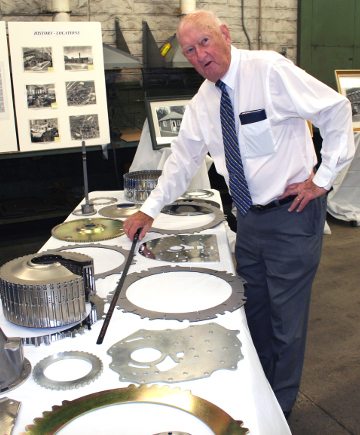
In 1950, the company purchased its current facility to consolidate operations under one roof. Over the decades, product lines expanded to include spacer plates, Belleville springs, marine engine couplers, and transmission components. Nearly a dozen additions have expanded the original plant into the 175,000-square-foot facility that stands today.
Leadership of the company continued through multiple generations. In 1968, E. C. Styberg Jr. was elected president and served in that role for fifty years. In 2018, long-tenured employee John Baker became president and led the company through the next phase of growth. In 2025, Jim Stachowiak became the fourth president in Styberg’s nearly 100-year history and the first to come from outside the organization.
Today, Styberg Engineering supports customers across aerospace, mining, material handling, trucking, and agricultural industries. The company operates presses up to 1,000 tons, Grob cold-forming spline machines, and advanced laser welding systems.
With nearly a century of manufacturing experience and a broad range of in-house capabilities, Styberg Engineering continues to build on its original foundation—delivering precision components, dependable quality, and practical engineering solutions for demanding industries.