How to Build Lighter, Stronger Transmissions with Cold-Formed Precision
Cold forming is transforming how critical drivetrain components such as clutch housings are manufactured, delivering measurable advantages over traditional casting. By reshaping steel rather than melting it, the process eliminates common casting defects like porosity and shrinkage while improving material strength. It also enables significant weight reduction. In many applications, replacing a cast clutch housing with a cold-formed alternative removes more than 50 pounds from the component, improving transmission efficiency, performance, and durability.
The evolution of drivetrain component manufacturing at Styberg Engineering Company is closely tied to its longstanding investment in Ernst Grob AG technology. What began in the late 1980s with a single Grob machine has grown into a core capability that defines Styberg’s position as a leader in large-diameter cold-formed transmission components.
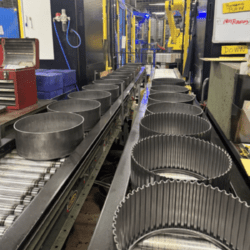
The Grob Advantage
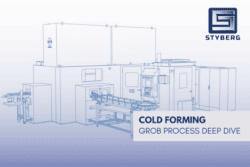
Grob developed an advanced system of cold forming that uses controlled pressure to displace and shape steel at or near room temperature. The result is a refined grain structure that increases tensile strength, fatigue resistance, and hardness, key requirements for components subjected to continuous torque and stress. The process produces near-net shapes with excellent surface finishes, reducing the need for secondary machining. Because metal is redistributed rather than removed, the process also minimizes material waste.
The impact of this technology is especially evident in the production of large, cylindrical parts such as 13-inch diameter clutch housings. These components are commonly used in medium- to heavy-duty off-highway transmissions and require uniform strength around the entire circumference.
Cold forming achieves this through a rotational process where a preformed can is mounted on a mandrel and spun while rollers apply force, allowing the metal to flow evenly into its final shape. The result is a high-precision, load-bearing part that meets demanding performance requirements while remaining lighter and more efficient than a casting.
From one single machine in the 1980s, Styberg expanded its capabilities over 40 years to include two more Grob systems. Styberg recently made its fourth Grob purchase, a new four-roller, CNC-controlled machine set to further advance production when it is installed this summer. Earlier Grob models relied on gear-driven systems and two-roller configurations. The capital investment will position Styberg customers for greater precision, faster cycle times, and the flexibility to produce a wider range of spline configurations. In fact, the newest system can produce parts approximately 2.5 times faster than Styberg’s existing machines, significantly increasing throughput while maintaining tight tolerances.
The Styberg Advantage
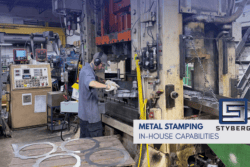
Beyond the machines themselves, Styberg’s true strength lies in its fully integrated approach. Styberg manages the entire manufacturing process in-house, beginning with raw material in coil form. Steel is stamped into a disc, drawn into a cup or can, and then processed on Grob equipment to cold form the splines. Additional operations, such as piercing holes, slotting features, trimming, and adding snap ring grooves, are completed using custom-designed tooling built by Styberg’s engineering & tooling teams. This vertical integration ensures quality, consistency, and speed from start to finish.
Styberg’s in-house expertise allows the company to support a wide range of part sizes as well as unique and legacy applications. When a midwestern transmission builder needed clutch housings for older transmission platforms, some dating back 50 years, Styberg jointly partnered with Grob to develop and meet customer specifications. Modern cold forming combined with in-house tooling development allowed our customer to reproduce and improve components that were no longer available, extending the life of critical equipment.
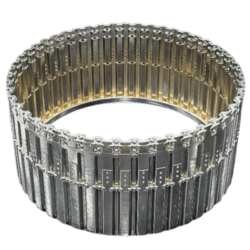
Cold forming provides a powerful solution to produce high strength, highly critical drivetrain components for passenger cars, electric 2-speed vehicles, and medium and heavy duty off-highway equipment. In addition to their strength, precision, and efficiency, Grob machines make a more sustainable, cost-effective part and a repeatable, high-performance process.
For manufacturers evaluating alternatives to casting or if you are looking for reliable, high-quality metal fabrication, contact us today.