Why Styberg’s Grob Investment Gives OEMs a Competitive Advantage
When engineers and purchasing managers evaluate manufacturing partners, equipment capability often determines whether a supplier can meet demanding performance, quality, and cost targets. Styberg Engineering & Manufacturing’s long-term investment in Ernst Grob cold-forming technology gives OEMs access to manufacturing capabilities that few suppliers can offer.
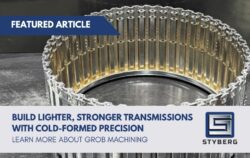
E. C. Styberg Jr. purchased Styberg’s first Grob cold-forming machine in 1987 and has continued investing in the technology for nearly four decades. Grob’s proprietary cold-forming process creates internal and external splines without traditional machining. Instead, the machine incrementally forms spline profiles through thousands of precisely controlled forming strokes. This process creates highly accurate spline geometries while reducing material waste, minimizing secondary operations, and increasing production efficiency.
For OEMs producing transmissions, drivetrains, and heavy-duty powertrain components, Styberg’s continued capital investment translates directly into manufacturing advantages. That commitment has allowed Styberg to build deep process knowledge while continuously expanding capacity, increasing productivity, and improving precision.
Styberg currently operates three Grob machines:
- a 14-NC constructed in 1997
- a second 14-NC constructed in 2003
- our latest addition, a $2.5 million investment in a 12-NCT, constructed in 2025
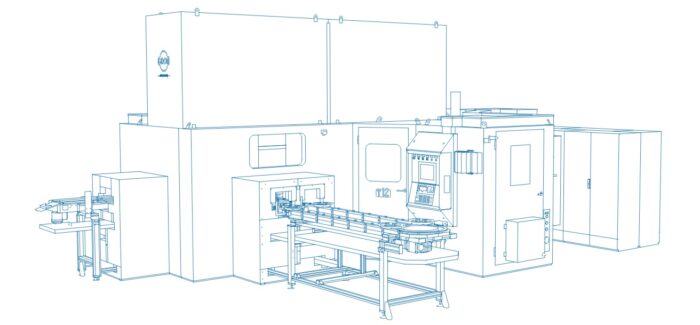
The 12-NCT is almost identical to the T12 cold-forming machine on Grob’s website, with difference being the carriage setup. The T12 is Grob’s largest spline machine, a CNC-controlled model featuring a four-roller design that delivers greater flexibility for complex spline configurations and significantly higher production rates than earlier generations. It has a one piece carriage, directly housing the torque motor, designed mainly for smaller lighter workpieces.
The 12-NCT has a two piece carriage and is designed for larger and heavier workpieces. The front carriage houses the spindle and the following carriage houses the torque motor. The spindle and torque motor are then connected by a coupling to protect the torque motor from larger direct forming impacts.
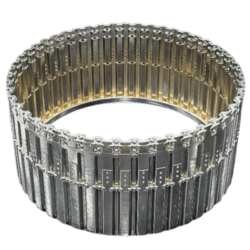
Both the T12 and 12-NCT are mainly used for the splining of clutch carriers and other rotationally symmetrical hollow parts, but they can also form large profiles on solid material parts without any problems. CNC controls, improved indexing technology, and a four-roller design increase throughput, improve repeatability, and enable more complex spline configurations.
“Today’s Grob machine has more than double the speed, higher precision, and stronger forming capabilities than the machine Styberg first purchased 40 years ago,” said Kevin Diezi, Sales Manager for Ernst Grob AG. “The 12-NCT cold forming machine is characterized by very short cycle and setup times, high process stability and minimal tool costs, making it ideal for a wide range of applications where high quality and low manufacturing costs are required.”
Styberg has leveraged the Grob technology to produce large-diameter transmission clutch housings and related drivetrain components for decades. The 12-NCT is a critical piece of equipment in our ability to manufacture orders of more than 100,000 parts per year. Without this technology, producing complex, precision-formed components such as clutch drums would require significantly more operations, tooling, machining, and material handling, making the process far more difficult and costly.
In many applications, Styberg helped OEMs replace large cast components with lighter cold-formed designs, reducing weight while maintaining strength and performance. The process has become a core capability for manufacturing heavy-gauge transmission components used in commercial vehicles, off-highway equipment, and other demanding applications.
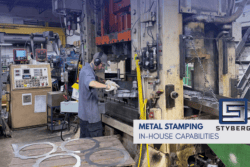
Styberg controls its entire production process, designing and building tooling in-house, stamping heavy-gauge blanks, deep draws, forming housings and completing secondary operations such as slotting, piercing, machining, heat treating, and assembly. This vertical integration allows Styberg to optimize manufacturability, accelerate program launches, and maintain tighter control over quality and lead times. The newest Grob machine further expands those capabilities.
As transmission designs evolve and OEMs demand stronger, lighter, and more efficient components, Styberg can respond with proven manufacturing technology backed by nearly 40 years of continuous investment and application knowledge.
“Our investment in Grob technology has always been about much more than adding another piece of equipment to our factory. For nearly 40 years, we’ve built deep process knowledge around this technology and used it to help our customers solve increasingly complex manufacturing challenges and grow their programs with us,” said Mitch McCaffery, Vice President of Business Development & Engineering for Styberg.
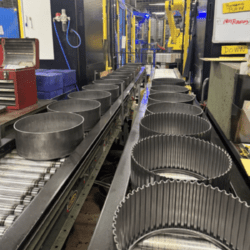
Over time, Styberg has continued to evolve how Grob technology is utilized, including more recent investments in robotics and conveyor systems that allow Styberg to move parts through the production process faster, more efficiently and with less handling.
“Our cold forming knowledge, through Styberg’s investments in Grob machines, is also helping us think differently about the future of manufacturing, including how AI, automation and new technologies can make our people and processes more capable,” McCaffery said. “The knowledge we’ve gained over decades directly influences how we evaluate and make investments for the future. Strong businesses don’t remain strong by standing still. They invest in the right technology, develop their people and continually improve how they serve their customers.”
If you want a manufacturing partner with world-class cold forming capabilities and the expertise to solve complex manufacturing challenges, contact us today.